Tesla Tests First Cybercab in Austin, Texas
TSLA News, Tesla Cybercab, Autonomous Vehicle, Electric Taxi
Tesla Begins Engineering Testing of Its First Production Cybercab in Austin, Texas
No steering wheel, no pedals, and no driver: Tesla’s first production Cybercab has entered engineering testing on public roads in Austin, Texas, marking a pivotal moment for autonomous vehicles and the future of everyday mobility.
From Vision to Reality: What Is the Tesla Cybercab?
The Tesla Cybercab is Tesla’s purpose-built autonomous vehicle, designed from the ground up to operate as a fully driverless electric taxi. Unlike a converted Model 3 or Model Y, this compact two-seat EV has been engineered specifically for robotaxi service: there is no steering wheel, no pedals, and no expectation that a human will ever take over driving in normal operation (TechSpot).
Production of the Cybercab began at Tesla’s Gigafactory in Texas earlier in 2026, with Elon Musk cautioning that initial output would be “agonizingly slow” as new parts and supply chains ramp up (Bloomberg). The move into engineering testing in Austin, Texas, is the next step toward commercial deployment, and it is already one of the most closely watched pieces of TSLA news this year.
Austin, Texas: Ground Zero for Tesla’s Driverless Future
It’s no coincidence that Austin, Texas is the first city where Tesla is testing a production-ready Cybercab without pedals or a steering wheel. The city is home to Gigafactory Texas, a fast-growing tech workforce, and an existing pilot fleet of Tesla robotaxis based on modified Model Ys. According to TechCrunch, Tesla began public road testing of the fully autonomous Cybercab here on June 30, 2026, with a safety monitor seated in the passenger seat as an added layer of oversight.
For local residents, that means you may soon spot a sleek, minimalist vehicle gliding through downtown or circling the airport pickup lane—with no one in the driver’s seat. For Tesla, Austin is a living laboratory: a place to validate hardware, refine software, and gather real-world data before the Cybercab expands to other cities and countries.
Inside the Cybercab: No Steering Wheel, No Pedals, Just “Point A to B”
The most striking thing about the Tesla Cybercab is what’s missing. Step inside and you won’t find a steering wheel, pedals, or traditional instrument cluster. Instead, the cabin is built around passengers, not drivers. Seating is optimized for two adults, with upgraded cushions, ambient interior lighting, frameless windows, and a durable trunk area for luggage (Notebookcheck).
Instead of driving controls, passengers interact with a simple digital interface—on a screen in the car and through the Tesla Robotaxi app on their phones. You choose your pickup point and destination, confirm the route, and the Cybercab does the rest. It’s true point A to B functionality: you summon, ride, and exit, without ever thinking about steering angles or brake pressure.
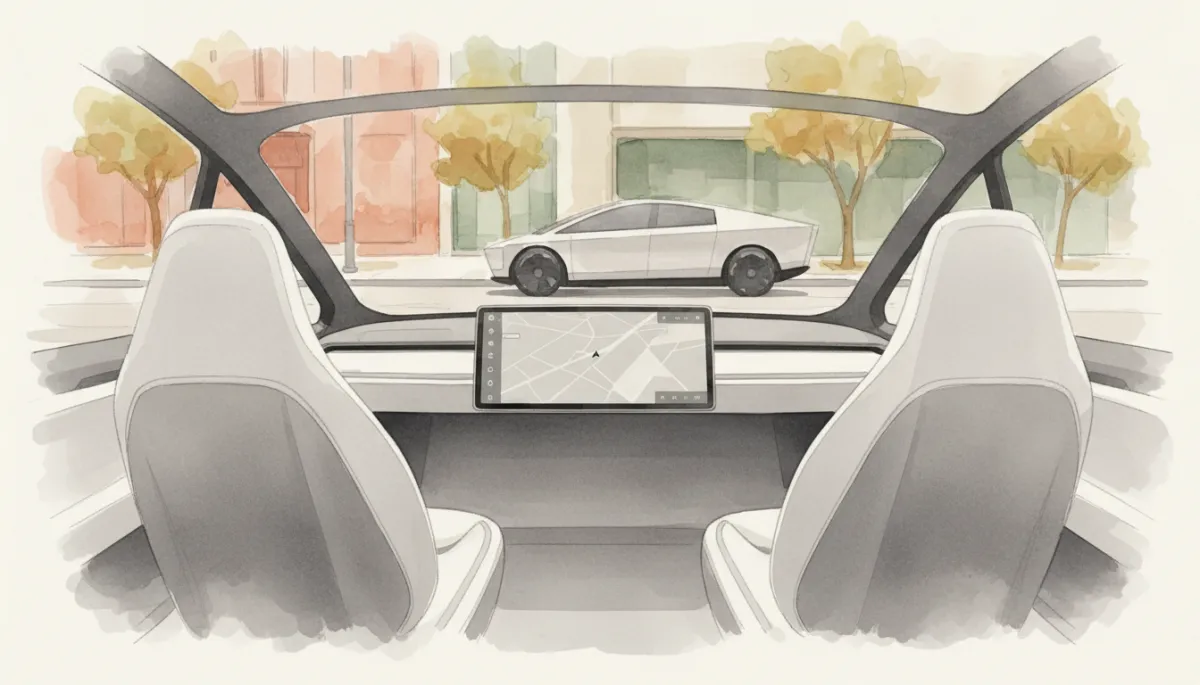
Cybercab’s driverless cabin shifts focus from driving controls to pure passenger comfort.
Under the Skin: Electric Taxi Power, Range, and Charging
Beneath its minimalist shell, the Tesla Cybercab is built to work hard as an electric taxi. It uses a lightweight, efficient architecture with a roughly 48 kWh battery pack and a front-wheel-drive layout powered by a 163 kW (219 hp) motor (MotorTimes). Despite the relatively modest battery size, early EPA data suggests a real-world range of around 300 miles per charge—more than enough for a full day of urban duty.
Charging is where the Cybercab begins to look truly futuristic. Tesla has secured regulatory approval to use ultra-wideband (UWB) radio technology to help position the vehicle precisely over ground-based inductive charging pads (Electrive). In practice, that means a Cybercab could roll into a depot or designated curbside pad, align itself automatically, and recharge wirelessly—no cables to plug in, no human intervention required. Conventional Supercharger support remains, but over time, inductive charging could make 24/7 autonomous fleets far easier to operate.
How Autonomous Is It, Really?
The Cybercab is the purest expression yet of Tesla’s autonomy ambitions. It’s equipped with upgraded cameras—front-facing, cabin-facing, and even a trunk camera designed to spot forgotten items and potentially notify users via the app (Tesla Oracle). These feed into Tesla’s latest Full Self-Driving (FSD) software, which the company continues to refine through over-the-air updates and large-scale data collection from its global fleet.
Importantly, current testing in Austin still includes a safety monitor in the passenger seat, and U.S. regulators are actively shaping the rules for vehicles that have no traditional controls. The National Highway Traffic Safety Administration (NHTSA) has proposed regulations that would allow fully autonomous vehicles like the Cybercab to be exempt from requirements for brake pedals and other human-centric controls (TechCrunch). If finalized, these rules could remove one of the last major legal roadblocks to large-scale deployment.
Safety, Scrutiny, and the Road to Trust
As exciting as the Cybercab is, it arrives in a climate of intense safety scrutiny. Tesla’s early robotaxi programs, which used modified Model Ys in cities like Austin, have experienced a higher rate of minor crashes than human-driven vehicles, according to NHTSA filings—roughly four times more, though generally low in severity (TechRadar). At the same time, separate investigations into FSD’s performance in edge cases, including a fatal crash in Texas, are ongoing.
Tesla is responding on multiple fronts: improving its neural networks with faster compilers, expanding 24-hour dashcam recording with detailed overlays, and publishing guidance for first responders on how to interact safely with autonomous vehicles in emergencies. For the Cybercab, the company says the vehicle can remain stationary and wait for remote assistance from Tesla in complex emergency scenarios, rather than making unpredictable moves on its own.
📌 Key Takeaway: The Cybercab’s success will depend as much on demonstrated safety and transparent oversight as on its impressive technology and futuristic design.
What the Cybercab Could Mean for Everyday Riders
For individuals, the promise of the Tesla Cybercab is simple: affordable, on-demand transportation that feels more like summoning a personal shuttle than hailing a traditional taxi. With no driver to pay and a highly efficient electric powertrain, Tesla aims to drive per-mile costs well below today’s ride-hailing prices, especially in dense urban areas such as central Austin, Texas.
Imagine landing at Austin–Bergstrom International Airport, opening the Tesla app, and requesting a Cybercab. Within minutes, a driverless vehicle pulls up to the curb, recognizes you via your phone, unlocks automatically, and whisks you to your hotel while you answer emails, make a call, or simply watch the city roll by. No small talk, no tipping, and no worries about parking or navigating unfamiliar streets.
A Strategic Shift in Tesla’s Lineup and TSLA News Cycle
Beyond the cool factor, the Cybercab signals a deeper strategic shift for Tesla. Musk has said that, long term, Tesla’s lineup will be “almost entirely autonomous,” with the Roadster standing out as one of the few manually driven cars left in production (TechRadar). In that context, the Cybercab isn’t just another model; it’s the template for Tesla’s future.
That’s why every update about Cybercab production, regulatory progress, or testing in Austin quickly becomes headline TSLA news. If Tesla can prove that a no-steering-wheel, no-pedals robotaxi is safe, reliable, and profitable, it could unlock a recurring revenue stream that goes far beyond selling individual cars—a shift that many investors see as central to the company’s long-term valuation.
What to Watch Next as Cybercab Testing Expands
As Tesla continues engineering testing of the Cybercab in Austin, Texas, there are several key developments individuals should watch:
Regulatory approvals: Final NHTSA rules on driverless-only designs and any city- or state-level permits for commercial robotaxi service.
Safety data: Transparent reporting on crash rates, disengagements, and how Cybercabs compare with human drivers over time.
Pricing models: How Tesla positions Cybercab rides against Uber, Lyft, and traditional taxis in terms of cost and convenience.
User experience: Early rider reviews from Austin that highlight comfort, reliability, and any friction points in the driverless experience.
The Bottom Line: A New Era of Point‑to‑Point Mobility
The start of engineering testing for Tesla’s first production Cybercab in Austin, Texas, is more than just another product milestone. It’s a glimpse into a world where booking a ride doesn’t involve a driver at all—just an app, a destination, and a quiet, efficient autonomous vehicle that takes you from point A to point B with no steering wheel, no pedals, and very little friction.
For individuals, that could mean cheaper rides, less hassle, and new mobility options in cities that embrace this technology. For Tesla, it represents a bold bet that the future of transportation is not just electric, but truly autonomous. As the Cybercab quietly navigates the streets of Austin, the rest of the world is watching—and waiting—for its own first ride in a driverless electric taxi.