
SpaceX IPO's Impact on Austin's Economy
Austin Economy, SpaceX IPO, Regional Growth, Tech Investment, Job Creation, Economic Impact
How SpaceX’s IPO Could Reshape Austin’s Economy and Regional Growth
SpaceX’s long‑anticipated IPO is finally here, with the company aiming to raise up to $75 billion at a valuation that could approach $2 trillion. While headlines focus on Wall Street and global markets, the most profound and lasting impact may be felt in regions already entwined with SpaceX’s growth story—especially the Austin metro and surrounding Central Texas counties. For local businesses, agencies, and economic development leaders, understanding how this Spacex IPO connects to the Austin economy, job creation, tech investment, and broader economic impact is now a strategic imperative, not a theoretical exercise.
The SpaceX IPO in Context: Why Austin Should Pay Attention
SpaceX confidentially filed for its IPO in April 2026 and began its roadshow in early June, targeting a mid‑June listing on the Nasdaq Global Select Market under the ticker SPCX. The offering—roughly 555.6 million shares at $135 per share—could become the largest IPO in history, raising around $75 billion in fresh capital and crystallizing a valuation north of $1.75 trillion, according to reporting from Axios and TechCrunch.
For the Austin economy, the immediate question is not whether local companies can buy SpaceX stock, but how this surge of capital and visibility will accelerate on‑the‑ground projects already underway in Central Texas. SpaceX is no longer just a rocket company; it is building Starlink satellite infrastructure, in‑house GPUs, and AI‑driven orbital data centers—many of which intersect directly with Austin’s strengths in semiconductors, advanced manufacturing, and software. The IPO is the financial engine that can push these initiatives from ambitious plans into scaled reality, with Austin positioned as one of the primary beneficiaries of the resulting regional growth.
Capital, Confidence, and the Next Chapter of the Austin Economy
The Austin economy has already experienced a decade of explosive expansion, driven by software, creative industries, and the arrival of mega‑projects like Tesla’s Giga Texas. SpaceX’s IPO adds a powerful new layer: global investor attention and liquidity focused on space, AI, and semiconductor infrastructure—exactly the domains where Central Texas is rapidly building capacity. When a company of SpaceX’s scale goes public, it doesn’t just create paper wealth; it resets how investors, suppliers, and talent perceive every region tied to its operations.
As SpaceX deploys IPO proceeds into Starship launches, next‑generation Starlink satellites, and AI‑centric manufacturing, it will lean heavily on ecosystems that can deliver engineering talent, power, land, and a cooperative regulatory environment. Austin and its neighboring counties already meet many of these criteria. The result is likely to be a reinforcing loop: a stronger SpaceX balance sheet funds more local projects, which in turn elevate the region’s profile and attract further tech investment from adjacent sectors such as cloud computing, defense tech, logistics, and advanced materials.
📌 Key Takeaway: The Spacex IPO is not a distant financial event—it is a catalyst that can deepen Austin’s role as a national hub for space, AI, and semiconductor innovation.
Terafab and Beyond: How SpaceX’s Capital Plan Ties Directly to Central Texas
One of the clearest links between the SpaceX IPO and Austin’s regional growth is the Terafab semiconductor initiative. Backed by SpaceX, Tesla, xAI, and Intel, Terafab is envisioned as a vertically integrated chip manufacturing and advanced computing complex with a footprint that stretches across the Austin region. Phase 1 alone is estimated at $55 billion in capital expenditure, with a full build‑out potentially exceeding $100 billion, according to industry reports. A research fab is planned for the Giga Texas North Campus in Austin, while a large‑scale production fab is slated for Grimes County, roughly 90 miles northeast.
SpaceX’s S‑1 filing makes clear that IPO proceeds will support in‑house GPU manufacturing and AI‑oriented infrastructure—precisely the capabilities Terafab is designed to deliver. For local agencies and economic development organizations, this linkage is crucial: the stronger SpaceX’s balance sheet becomes after the IPO, the more likely it is that Terafab timelines accelerate, scope expands, and complementary projects—from power infrastructure to logistics hubs—are green‑lit in and around Austin. In other words, the IPO underwrites not just rockets and satellites, but a new industrial backbone for the region.
Job Creation: From Bastrop to Grimes County, a New Industrial Workforce
SpaceX’s existing and planned facilities around Austin already provide a preview of the job creation trajectory. In Bastrop County, east of the city, SpaceX is executing a roughly $280 million expansion that will add about 1 million square feet of manufacturing space and more than 400 new jobs focused on silicon packaging and Starlink hardware. A separate $855 million Starlink kit production expansion, backed by a state Enterprise Zone nomination, aims to support output of up to 10 million kits annually by the end of 2026. Local reporting indicates the company is currently recruiting 100–150 additional employees on top of an existing workforce of more than 1,500 in the area.
These are not isolated figures. Terafab’s long‑term ambitions suggest thousands of additional roles spanning chip design, fabrication, cleanroom operations, construction, facilities management, and supply chain logistics. For comparison, Samsung’s Austin semiconductor operations generated $19.8 billion in economic activity and supported more than 38,000 jobs in 2024. Tesla’s Giga Texas created billions more in local sales and employment. Given Terafab’s projected scale, it is reasonable to expect job creation that matches—or ultimately exceeds—these benchmarks across Central Texas, with SpaceX as a primary demand driver for high‑end compute and AI hardware.
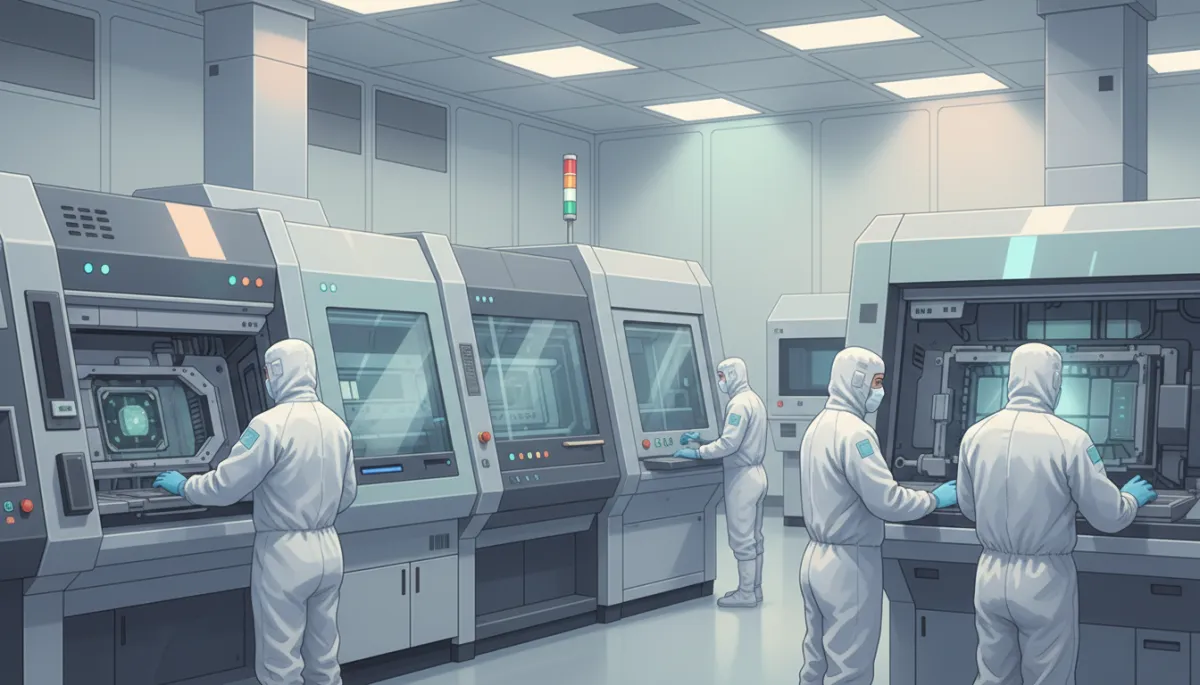
Advanced fabs near Austin could support tens of thousands of direct and indirect jobs over time.
The Multiplier Effect: Suppliers, Services, and the Wider Business Community
For businesses and agencies across the Austin economy, the most powerful benefits of the SpaceX IPO will arrive through multiplier effects rather than direct contracts alone. Large‑scale industrial projects require extensive support networks: construction firms, specialty engineering consultancies, environmental and permitting advisors, legal and financial services, workforce training providers, and a wide array of logistics and maintenance vendors. Every new cleanroom or data center in Bastrop or at Giga Texas translates into a cascade of new opportunities for local firms that can meet the standards of speed, quality, and compliance SpaceX demands.
At the same time, increased employment and wage growth in high‑skill sectors spill into consumer‑facing industries. More engineers and technicians in the region mean higher demand for housing, retail, healthcare, education, and cultural amenities. Municipal agencies and regional planners will need to coordinate investments in transportation, utilities, and community services to keep pace. For public‑sector stakeholders, this is an opportunity to align zoning, infrastructure, and incentives with a long‑term vision of balanced regional growth anchored by tech investment, rather than reacting to capacity challenges after the fact.
💡 Pro Tip for Local Businesses: Map your capabilities against the needs of large industrial projects—everything from precision machining to workforce housing—and proactively build relationships with primes and agencies now, before demand spikes.
Tech Investment and Innovation: Catalyzing a Space–AI–Semiconductor Cluster
The Spacex IPO also has a subtler but equally important effect: it validates entire technology categories and attracts capital into adjacent ventures. As institutional investors allocate billions into a space and AI infrastructure leader, they inevitably scan for complementary opportunities—startups building ground‑segment software, sensor systems, cybersecurity for satellites, orbital manufacturing concepts, or tools for managing AI workloads in extreme environments. Austin’s existing strengths in cloud software, developer tools, and cybersecurity position local founders to capture this wave of tech investment.
Venture capital firms and corporate investors already active in Austin will likely sharpen their focus on “dual‑use” technologies that can serve both terrestrial and space markets. For example, an Austin‑based AI startup working on energy‑efficient inference chips might find new customers in SpaceX’s orbital data center plans, while also partnering with Terafab on chip design or packaging. Similarly, logistics and automation companies that cut their teeth supporting Tesla’s automotive lines could adapt their solutions to the demands of high‑throughput satellite kit production. The IPO acts as a signal flare that space‑adjacent innovation is not a niche, but a core pillar of the global tech economy.
Regional Growth: From Metro Austin to the Broader Central Texas Corridor
While downtown Austin often captures the spotlight, the economic impact of SpaceX’s IPO will be distributed across a much broader geography. Bastrop County, already home to major Starlink manufacturing operations, is seeing infrastructure upgrades, cleanroom construction, and state‑backed incentives. Grimes County, targeted for Terafab’s production fab, could experience a structural shift from agriculture and legacy industries toward advanced manufacturing and high‑tech services. The resulting regional growth will knit together a corridor of innovation stretching from Austin to College Station and beyond, with new patterns of commuting, freight movement, and energy demand.
For regional planners and agencies, this raises both opportunities and responsibilities. Coordinated investment in highways, rail, and broadband will be essential to support workforce mobility and supply chain efficiency. Educational institutions—community colleges, universities, and vocational programs—will need to align curricula with the skills required in semiconductor fabrication, aerospace manufacturing, and AI operations. Economic development organizations can play a pivotal role by aligning incentives across county lines, rather than competing for individual facilities, and by positioning Central Texas as an integrated, resilient ecosystem for large‑scale industrial innovation.
Managing Risk and Ensuring Sustainable Economic Impact
SpaceX’s S‑1 filing is candid about the risks surrounding many of its most ambitious projects. Orbital AI compute, space‑based data centers, and point‑to‑point Earth transportation all involve unproven technologies and significant technical complexity. For Austin‑area stakeholders, this means that while the upside of partnership with SpaceX is enormous, it should be balanced with a focus on resilience. Over‑reliance on a single corporate anchor can expose local economies to volatility if strategies shift or projects are delayed.
The most robust economic impact will come from using the SpaceX IPO as a springboard to diversify, not concentrate, the regional economy. That could mean encouraging a mix of suppliers that also serve other semiconductor and aerospace customers, supporting startups with multiple potential markets, and investing in infrastructure—such as power, water, and transportation—that benefits residents and businesses regardless of any single employer’s trajectory. By grounding growth in broad‑based capacity rather than one company’s roadmap, Austin and its neighboring counties can convert a historic IPO into durable prosperity.
📌 Key Takeaway for Agencies: Pair targeted incentives for SpaceX‑linked projects with parallel investments in workforce development, infrastructure, and small‑business support to spread the benefits of regional growth.
Action Steps for Businesses and Agencies in the Austin Region
With the Spacex IPO moving from rumor to reality, local leaders have a narrow but meaningful window to position themselves. Consider the following strategic moves:
Audit your capabilities against the needs of aerospace, semiconductor, and AI infrastructure projects—whether that is specialized construction, precision manufacturing, cybersecurity, or workforce training.
Engage with regional partnerships that connect Austin, Bastrop, and surrounding counties, ensuring your organization has a voice in cross‑jurisdiction planning and incentive design.
Strengthen talent pipelines by collaborating with universities, community colleges, and training providers on programs aligned with semiconductor fabrication, advanced manufacturing, and AI operations.
Monitor capital flows from the SpaceX IPO and related mega‑offerings (such as OpenAI or Anthropic) to understand where investors are placing long‑term bets and how that aligns with your growth strategy.
Plan for infrastructure stress—from energy demand to housing availability—and work with public agencies to advocate for timely upgrades that keep pace with industrial expansion.
Conclusion: Turning a Historic IPO into a Regional Advantage
SpaceX’s IPO is poised to be one of the defining financial events of this decade. For the Austin economy and the wider Central Texas region, its significance goes far beyond ticker symbols and opening‑day price swings. The capital raised will power Starship launches, Starlink expansion, AI‑driven infrastructure, and in‑house semiconductor capabilities—many of which are already finding a home in and around Austin through Bastrop manufacturing, Terafab, and Giga Texas initiatives. That translates into tangible regional growth, job creation across skill levels, and a surge of tech investment into space‑adjacent and semiconductor‑driven innovation.
For businesses and agencies, the challenge—and the opportunity—is to treat this moment as the beginning of a strategic decade, not a short‑lived news cycle. By aligning local capabilities with global demand, coordinating regional planning, and investing in resilient infrastructure and talent, Austin can convert the economic impact of the Spacex IPO into a durable competitive advantage. In doing so, the region stands to evolve from a fast‑growing tech hub into a cornerstone of the world’s emerging space, AI, and semiconductor economy—a place where the next generation of industrial innovation is not only funded, but built.